

BAOHUA Automatic 3D Wheel Alignment Machine
A floor-standing 3D wheel alignment system for passenger-vehicle workshops and tire service centers, supplied with cameras, targets, wheel clamps, computer, monitor, and turntables.
View details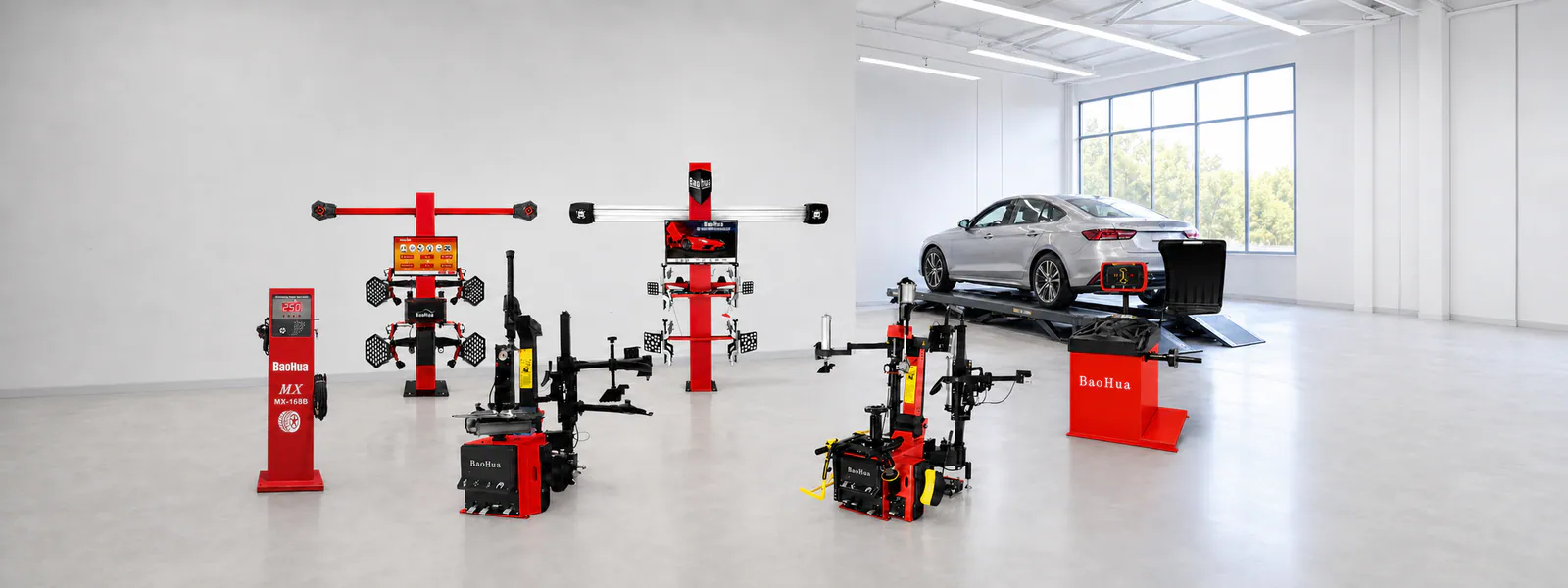
CURRENT RANGE
Check each model page for its listed wheel range, vehicle application, configuration, and available product information. Confirm accessories, utilities, software or database scope, and destination requirements for the exact model.
A floor-standing 3D wheel alignment system for passenger-vehicle workshops and tire service centers, supplied with cameras, targets, wheel clamps, computer, monitor, and turntables.
View details
Automatic passenger-car tire changer with a tilt-back arm, 55 x 55 mm working arm and adjustable four-jaw turntable. Maximum wheel diameter: 1100 mm; maximum width: 356 mm.
View details
The BH-526Pro is an automatic tilt-back tire changer for passenger-car tire service, using a conventional mounting head and tire lever. It combines a roller-guided 55 × 55 mm push-pull arm, a Help 5 pneumatic helper-arm system and a fully sealed 180 mm bead-breaker cylinder. Internal clamping covers 12–26 inches and external clamping covers 10–24 inches. Maximum wheel diameter is 1120 mm and maximum wheel width is 420 mm. Select the appropriate 220 V or 380 V configuration for the workshop. This is not a leverless tire changer.
View details
V9120 leverless car tire changer with a pneumatic tilt-back column, flip-type mounting head, pneumatic wheel lift and rotating assist arm for 10–26 inch rims.
View details
A CCD wheel alignment system for heavy trucks, tractors, trailers and multi-axle commercial vehicles, with guided measurement functions for workshop alignment service.
View details
Heavy-duty DSP-CCD wheel and axle alignment with a frame-centerline reference, rolling compensation and Wi-Fi data transfer. Choose cabinet or flight-case configuration at the same price.
View details
CB250P wheel balancer with manual wheel dimension input, static and dynamic modes, dual LED readings and laser-guided adhesive weight placement. For wheels up to 70 kg and 1100 mm diameter.
View details
Heavy-duty tire changer for 14–26 inch rims, with 500 kg maximum wheel weight, 1600 mm maximum tire diameter, 780 mm wheel width and a positionable 24 V control unit.
View details
Semi-automatic heavy-duty tire changer for 14-42 inch rims and wheels up to 1600 kg, with 2300 mm maximum wheel diameter, 1050 mm width and movable 24 V controls.
View details
Dual-speed heavy-duty tire changer for 14–46 inch rims, extending to 14–56 inches with extensions. Handles wheels up to 2000 kg, 2500 mm diameter and 1200 mm width.
View details
Truck and bus wheel balancing for wheels up to 150 kg and 1200 mm diameter, with 13-24 inch rims and an 8-second listed test time. CH205 pneumatic loading lift rated separately at 75 kg.
View details
Floor-standing automatic tire inflator for workshop inflation and deflation service, with LED digital display, 5-101 psi measuring range and 40 W electrical power.
View details
ML-3D-T1 is a camera-based 3D wheel alignment system for tire shops and automotive service centers, with 5 MP industrial cameras, a 32-inch monitor and four hexagonal targets. Three-point wheel clamps support the listed 11–25 inch wheel range.
View details
CB650P car wheel balancer with a 21.5-inch LCD display, static and dynamic balancing modes, automatic distance and diameter measurement, split-weight positioning and a 355 mm shaft assembly. Automatic width measurement is an optional configuration.
View detailsSELECTION GUIDE
A tire shop often needs several machines working together. Use the table to match each service operation with the wheel, vehicle, site, and workflow information that should be confirmed.
| Workshop application | Equipment to review | Information to confirm |
|---|---|---|
| Passenger-car tire changing | Automatic car tire changer | Rim diameter and width, tire profile, run-flat requirement, clamping method, assist arm, power, and air supply |
| Passenger-car wheel balancing | Automatic wheel balancer | Wheel diameter, width, maximum wheel weight, shaft and cone accessories, power, and balancing workflow |
| Passenger-vehicle alignment | 3D wheel alignment system | Vehicle range, bay dimensions, lift or pit, camera position, target and clamp scope, power, and database region |
| Truck and bus tire service | Heavy-duty tire changer and balancer | Rim and tire range, maximum wheel weight, vehicle type, workshop access, handling method, power, and controls |
| Commercial-vehicle alignment | Heavy-duty wheel aligner | Axle configuration, wheelbase, vehicle dimensions, bay or pit layout, sensor scope, database, and calibration support |
BUYER FAQ
These answers support early equipment selection. Final working ranges, accessories, utilities, software, installation, and document scope must be confirmed for the exact model.
The required equipment depends on the services offered. A typical planning list may include a tire changer, wheel balancer, tire inflator, suitable vehicle lift, and wheel alignment equipment. Truck and bus service requires wheel ranges, handling, controls, and site layouts suited to heavy-duty applications.
Provide the tire and rim diameter range, rim width, tire profile, run-flat or low-profile requirement, passenger or commercial vehicle application, expected workload, available power and compressed air, required accessories, destination, and quantity.
Confirm the wheel diameter and width range, maximum wheel weight, passenger or commercial vehicle application, balancing workflow, required cones and adapters, display or automation preference, power supply, and daily workload.
Send the vehicle range, wheelbase and track range, lift or pit details, bay dimensions, camera or sensor working space, required database region and language, accessory list, calibration plan, power supply, and support expectations.
Passenger-car and heavy-truck tires differ significantly in wheel size, weight, handling, and operating method. Confirm the full wheel range and intended vehicle types rather than assuming one machine covers both applications.
Requirements vary by model. Confirm voltage, frequency, phase, electrical capacity, compressed-air pressure and flow where applicable, floor space, access, lighting, network needs, and safe wheel-handling routes.
Document availability depends on the exact product, model, configuration, destination, and order. Request model-specific product, installation, software, compliance, and commercial document confirmation during the inquiry.
PROJECT SUPPORT
We will help organize the equipment list and identify the questions that must be confirmed before quotation and installation.
Start a project brief