
VEHICLE LIFTING
How to choose a two-post car lift for your workshop
A practical buyer checklist covering vehicle range, rated capacity, bay dimensions, concrete, power, and quotation details for a two-post lift.
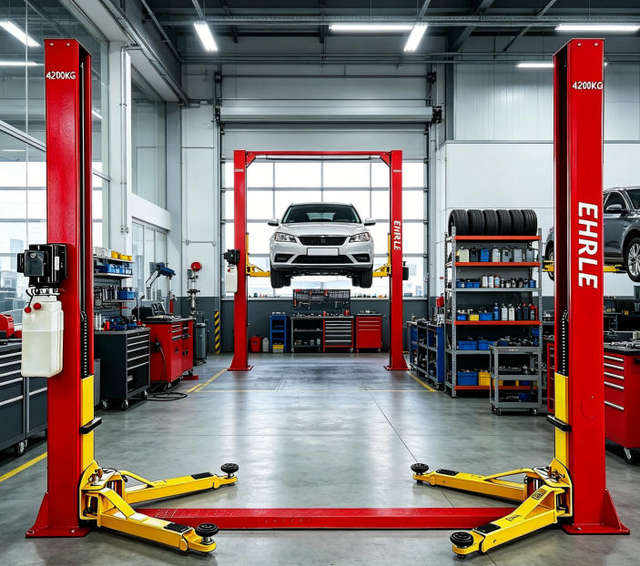
Begin with the vehicles and work you expect
Capacity is only one part of lift selection. List the lightest and heaviest vehicles you expect, their wheelbases, pickup points, ground clearance, and the service work performed in the bay.
A lift that suits routine passenger-car maintenance may require different arms, adapters, column spacing, or capacity when the workshop also handles long-wheelbase vans, electric vehicles, or light commercial vehicles.
Confirm the usable bay, not only the machine width
Compare the overall lift dimensions with the clear workshop space. Include vehicle approach, door opening, technician movement, tool trolleys, overhead obstructions, and routes around the raised vehicle.
Ask for a dimension drawing for the exact configuration. Similar-looking models may have different column heights, drive-through widths, arm reaches, and control-side requirements.
- Clear bay width, length, and ceiling height
- Largest expected vehicle dimensions and weight
- Door, beam, lighting, and overhead-service positions
- Preferred control side and vehicle approach direction
Treat the floor and foundation as a project input
Concrete thickness, condition, strength, reinforcement, joints, cracks, and embedded services affect installation. Do not assume that an existing slab is suitable because another machine is already installed nearby.
Send the supplier accurate site information and follow the model-specific installation documentation. Where required, have the slab or foundation checked by a qualified local professional before installation.
Check power, controls, safety features, and service access
Confirm available voltage, frequency, and phase before the quotation is finalized. Compare the release system, locking arrangement, synchronization method, lifting pads, included adapters, and options against the workshop workflow.
Also ask how routine inspection, lubrication, adjustment, spare parts, and technical support are handled. A clear maintenance plan is part of choosing the right equipment.
Information to send with your inquiry
A useful quotation starts with a short, specific project brief. Include the items below and request confirmation against the exact model offered.
- Vehicle types, maximum weight, wheelbase, and ground clearance
- Workshop layout or clear bay dimensions
- Power supply at the installation site
- Required adapters, options, and intended service work
- Destination country, delivery point, and requested quantity
- Required product, installation, and compliance documents
Compare BAOHUA Two-Post Lift Models
Compare the published model specifications before choosing equipment for your workshop.
| Specification | Standard 4.2T | 4200kg Heavy-Duty | EC500 5T | EC600 6T |
|---|---|---|---|---|
| Capacity | 4,200 kg | 4200Kg | 5,000 kg | 6000 kg |
| Lift type / structure | Floor plate type two-post lift | Two post car lift | Overhead two-post hydraulic lift | Asymmetric two-post hydraulic vehicle lift |
| Overall height | UNKNOWN | 2780mm | 3,720 mm | 4500 mm |
| Overall width | 3,530 mm | 3370mm | 3,500 mm | 3550 mm |
| Clear width between posts | 3,000 mm | 2790mm | 2,840 mm | 2840 mm |
| Power options | 220 V / 380 V | 110v/220v/380v | 110 V / 220 V / 380 V | 110 / 220 / 380 / 415 / 440 V, 50/60 Hz (configuration-dependent) |
| Typical application | Independent repair workshops; Dealership service bays; Vehicle inspection; Underbody maintenance | Automotive repair workshops; Underbody inspection and maintenance | Passenger-vehicle repair workshops; Dealership service bays; Vehicle inspection; Underbody maintenance | Commercial-vehicle workshops; RV, van and light-truck maintenance |
UNKNOWN means the current product data does not state the value. Overall height is the equipment height, not a minimum ceiling-height requirement. Confirm vehicle fit, working clearance and the selected electrical configuration before ordering.
This guide supports early equipment planning. Final dimensions, specifications, installation instructions, supply scope, and applicable documents must be confirmed for the exact model and site before ordering.